
Four Cities, One Rule
Each session is a working day in its own city: 08:00 to 17:00 by the local clock, Monday to Friday. The trading day starts in Sydney and follows the sun west. Sydney and Tokyo together are often called the Asian session.
- Sydney08:00 to 17:00 localUTC+10, or UTC+11 on summer time, first Sunday of October to first Sunday of April
- Tokyo08:00 to 17:00 localUTC+9 all year: Tokyo never changes its clocks
- London08:00 to 17:00 localUTC, or UTC+1 on summer time, last Sunday of March to last Sunday of October
- New York08:00 to 17:00 localUTC-5, or UTC-4 on summer time, second Sunday of March to first Sunday of November
Some tables pin the sessions to New York time instead, Sydney at 17:00 to 02:00 and Tokyo at 19:00 to 04:00. Those hours drift against a city's own day whenever a city changes its clocks. Both are conventions: no authority fixes the sessions, and your broker's hours are the ones that count for your orders.
Session Times in 17 Time Zones
Each session's open and close for a week in July, when Europe and the United States are on summer time, and a week in January. (-1) is the day before the city's own date, (+1) the day after. For any other zone or week, use the graph above. India, Pakistan and Nigeria each have a page of their own, linked from their rows, with the weeks the hours shift there.
A Week in July
| Time zone | Sydney | Tokyo | London | New York |
|---|---|---|---|---|
| UTC | 22:00 (-1) to 07:00 | 23:00 (-1) to 08:00 | 07:00 to 16:00 | 12:00 to 21:00 |
| Broker server time (UTC+3) | 01:00 to 10:00 | 02:00 to 11:00 | 10:00 to 19:00 | 15:00 to 00:00 (+1) |
| Auckland (UTC+12) | 10:00 to 19:00 | 11:00 to 20:00 | 19:00 to 04:00 (+1) | 00:00 (+1) to 09:00 (+1) |
| Sydney (UTC+10) | 08:00 to 17:00 | 09:00 to 18:00 | 17:00 to 02:00 (+1) | 22:00 to 07:00 (+1) |
| Singapore (UTC+8) | 06:00 to 15:00 | 07:00 to 16:00 | 15:00 to 00:00 (+1) | 20:00 to 05:00 (+1) |
| Tokyo (UTC+9) | 07:00 to 16:00 | 08:00 to 17:00 | 16:00 to 01:00 (+1) | 21:00 to 06:00 (+1) |
| Mumbai, India (UTC+5:30) | 03:30 to 12:30 | 04:30 to 13:30 | 12:30 to 21:30 | 17:30 to 02:30 (+1) |
| Karachi, Pakistan (UTC+5) | 03:00 to 12:00 | 04:00 to 13:00 | 12:00 to 21:00 | 17:00 to 02:00 (+1) |
| Dubai (UTC+4) | 02:00 to 11:00 | 03:00 to 12:00 | 11:00 to 20:00 | 16:00 to 01:00 (+1) |
| Johannesburg (UTC+2) | 00:00 to 09:00 | 01:00 to 10:00 | 09:00 to 18:00 | 14:00 to 23:00 |
| Lagos, Nigeria (UTC+1) | 23:00 (-1) to 08:00 | 00:00 to 09:00 | 08:00 to 17:00 | 13:00 to 22:00 |
| London (UTC+1) | 23:00 (-1) to 08:00 | 00:00 to 09:00 | 08:00 to 17:00 | 13:00 to 22:00 |
| Berlin (UTC+2) | 00:00 to 09:00 | 01:00 to 10:00 | 09:00 to 18:00 | 14:00 to 23:00 |
| Sao Paulo (UTC-3) | 19:00 (-1) to 04:00 | 20:00 (-1) to 05:00 | 04:00 to 13:00 | 09:00 to 18:00 |
| New York (UTC-4) | 18:00 (-1) to 03:00 | 19:00 (-1) to 04:00 | 03:00 to 12:00 | 08:00 to 17:00 |
| Chicago (UTC-5) | 17:00 (-1) to 02:00 | 18:00 (-1) to 03:00 | 02:00 to 11:00 | 07:00 to 16:00 |
| Los Angeles (UTC-7) | 15:00 (-1) to 00:00 | 16:00 (-1) to 01:00 | 00:00 to 09:00 | 05:00 to 14:00 |
A Week in January
| Time zone | Sydney | Tokyo | London | New York |
|---|---|---|---|---|
| UTC | 21:00 (-1) to 06:00 | 23:00 (-1) to 08:00 | 08:00 to 17:00 | 13:00 to 22:00 |
| Broker server time (UTC+2) | 23:00 (-1) to 08:00 | 01:00 to 10:00 | 10:00 to 19:00 | 15:00 to 00:00 (+1) |
| Auckland (UTC+13) | 10:00 to 19:00 | 12:00 to 21:00 | 21:00 to 06:00 (+1) | 02:00 (+1) to 11:00 (+1) |
| Sydney (UTC+11) | 08:00 to 17:00 | 10:00 to 19:00 | 19:00 to 04:00 (+1) | 00:00 (+1) to 09:00 (+1) |
| Singapore (UTC+8) | 05:00 to 14:00 | 07:00 to 16:00 | 16:00 to 01:00 (+1) | 21:00 to 06:00 (+1) |
| Tokyo (UTC+9) | 06:00 to 15:00 | 08:00 to 17:00 | 17:00 to 02:00 (+1) | 22:00 to 07:00 (+1) |
| Mumbai, India (UTC+5:30) | 02:30 to 11:30 | 04:30 to 13:30 | 13:30 to 22:30 | 18:30 to 03:30 (+1) |
| Karachi, Pakistan (UTC+5) | 02:00 to 11:00 | 04:00 to 13:00 | 13:00 to 22:00 | 18:00 to 03:00 (+1) |
| Dubai (UTC+4) | 01:00 to 10:00 | 03:00 to 12:00 | 12:00 to 21:00 | 17:00 to 02:00 (+1) |
| Johannesburg (UTC+2) | 23:00 (-1) to 08:00 | 01:00 to 10:00 | 10:00 to 19:00 | 15:00 to 00:00 (+1) |
| Lagos, Nigeria (UTC+1) | 22:00 (-1) to 07:00 | 00:00 to 09:00 | 09:00 to 18:00 | 14:00 to 23:00 |
| London (UTC) | 21:00 (-1) to 06:00 | 23:00 (-1) to 08:00 | 08:00 to 17:00 | 13:00 to 22:00 |
| Berlin (UTC+1) | 22:00 (-1) to 07:00 | 00:00 to 09:00 | 09:00 to 18:00 | 14:00 to 23:00 |
| Sao Paulo (UTC-3) | 18:00 (-1) to 03:00 | 20:00 (-1) to 05:00 | 05:00 to 14:00 | 10:00 to 19:00 |
| New York (UTC-5) | 16:00 (-1) to 01:00 | 18:00 (-1) to 03:00 | 03:00 to 12:00 | 08:00 to 17:00 |
| Chicago (UTC-6) | 15:00 (-1) to 00:00 | 17:00 (-1) to 02:00 | 02:00 to 11:00 | 07:00 to 16:00 |
| Los Angeles (UTC-8) | 13:00 (-1) to 22:00 (-1) | 15:00 (-1) to 00:00 | 00:00 to 09:00 | 05:00 to 14:00 |
The London and New York Overlap
For four hours both cities are open: 08:00 to 12:00 in New York, 13:00 to 17:00 in London. Pick the weeks:
London time along the bottom. Together from 13:00 to 17:00 in London, 08:00 to 12:00 in New York. In UTC that is 13:00 to 17:00 in winter and 12:00 to 16:00 in summer, because both cities move their clocks.
When Europe and the United States change their clocks on different dates, London is four hours ahead of New York instead of five, and the overlap runs 12:00 to 17:00 in London, five hours. That happens from 25 October to 1 November 2026, 14 to 28 March 2027 and 31 October to 7 November 2027.
- Sydney + Tokyo share seven or eight hours of the Asian morning.
- Tokyo + London overlap for an hour in northern summer and not at all in northern winter.
Why the Hours Matter
When two centres are open at once, more banks and traders are quoting, and a market order usually finds a counterparty more easily. The Bank for International Settlements counted the currency market in April 2025:
That is why the London and New York hours are usually the most active. Most active is not the same as right for your strategy, though, and the spread you pay is set by your broker, symbol by symbol.
Spreads often look wider when few dealers are quoting, around the daily rollover for example. Watch your own broker's spread at the hours you trade.
Source: BIS Triennial Survey, press release of 30 September 2025. The 37 % is the 75 % less the United Kingdom's 38 %.
The Weekly Open and Close
The currency market has no opening bell, but it has a weekend. By convention the week opens on Sunday at 17:00 and closes on Friday at 17:00, New York time. Brokers open and close their servers close to those times, not always exactly at them.
In UTC the week opens at 21:00 while New York is on summer time and at 22:00 while it is on standard time. A session that would start before the weekly open is drawn from the open: Sydney's Monday morning, when New York is on standard time and Sydney on summer time.
Open and Close in 10 Time Zones
| Time zone | Opens in July | Closes in July | Opens in January | Closes in January |
|---|---|---|---|---|
| UTC | Sun 21:00 | Fri 21:00 | Sun 22:00 | Fri 22:00 |
| Broker server time (UTC+3) | Mon 00:00 | Sat 00:00 | Mon 00:00 | Sat 00:00 |
| Sydney (UTC+10) | Mon 07:00 | Sat 07:00 | Mon 09:00 | Sat 09:00 |
| Tokyo (UTC+9) | Mon 06:00 | Sat 06:00 | Mon 07:00 | Sat 07:00 |
| Singapore (UTC+8) | Mon 05:00 | Sat 05:00 | Mon 06:00 | Sat 06:00 |
| Dubai (UTC+4) | Mon 01:00 | Sat 01:00 | Mon 02:00 | Sat 02:00 |
| London (UTC+1) | Sun 22:00 | Fri 22:00 | Sun 22:00 | Fri 22:00 |
| Berlin (UTC+2) | Sun 23:00 | Fri 23:00 | Sun 23:00 | Fri 23:00 |
| New York (UTC-4) | Sun 17:00 | Fri 17:00 | Sun 17:00 | Fri 17:00 |
| Los Angeles (UTC-7) | Sun 14:00 | Fri 14:00 | Sun 14:00 | Fri 14:00 |
Futures Keep Their Own Hours
Currency, gold and index futures trade on CME Globex, the electronic market of CME Group. Its hours are set by the exchange, not by a city's working day, and the graph above shows them on their own lane.
One Exchange
The currency market has no central exchange: the four sessions are the working hours of its biggest centres. A futures contract trades in one place, on one exchange's system.
Fixed Hours
Sunday to Friday, 17:00 to 16:00 Chicago time: 23 hours a day, set by the exchange.
A Daily Break
Trading stops for 60 minutes each day, 16:00 to 17:00 Chicago time. In the zone picked above: 21:00 to 22:00 in UTC.
A Sunday Evening Open
The week starts at 17:00 Chicago time on Sunday, 18:00 in New York: an hour after the currency market's usual open. Both close at 17:00 New York time on Friday.
Your broker's gold and index symbols keep the broker's own hours, which can differ from the exchange's. The Specification window lists them: see Check It in MetaTrader below.
Hours from CME Group's contract specifications for Euro FX, Gold and E-mini S&P 500 futures on CME Globex, read 20 October 2026. Holiday hours differ: CME Group Holiday and Trading Hours.
Daylight Saving Weeks
Three of the four cities change their clocks, each on its own dates. Tokyo never does, and Chicago changes with New York. For a few weeks each spring and autumn the gaps between the cities are an hour off, and the graph shows a note on those days.
Out of step from 4 October to 1 November 2026
- Sunday 4 October 2026Sydney moves to summer time (UTC+11)
- Sunday 25 October 2026London goes back to standard time (UTC)
- Sunday 1 November 2026New York goes back to standard time (UTC-5)
Out of step from 14 March to 4 April 2027
- Sunday 14 March 2027New York moves to summer time (UTC-4)
- Sunday 28 March 2027London moves to summer time (UTC+1)
- Sunday 4 April 2027Sydney goes back to standard time (UTC+10)
Out of step from 3 October to 7 November 2027
- Sunday 3 October 2027Sydney moves to summer time (UTC+11)
- Sunday 31 October 2027London goes back to standard time (UTC)
- Sunday 7 November 2027New York goes back to standard time (UTC-5)
On the day the clocks change a day has 23 or 25 hours, and the graph shows which hour is missing or happens twice. The dates come from the IANA time zone database, read through your browser, so the graph follows the rules in every year.
Broker Server Time and the Daily Candle
MetaTrader's clock is not yours: Market Watch shows the broker's server time. Many servers run at UTC+2, and at UTC+3 while New York is on summer time, so 17:00 in New York is midnight on the server all year and the daily candle closes there.
Winter: UTC+2New York summer: UTC+3
Not every broker does this: some servers run on UTC or on their own city's time. The zone list above has broker server time with this rule; check the offset against your own Market Watch clock first.
Holidays
Thin or Closed Days
The graph shows ordinary weekdays. On public holidays such as Christmas Day and 1 January a market can be closed or thin, and brokers often shorten their hours. Look for your broker's holiday notice.
Futures Holidays
CME Globex keeps its own holiday hours, for example around Thanksgiving, 26 to 28 November 2026, and Christmas, 24 to 26 December 2026. Its calendar is linked above.
In MetaTrader, the panel minds the hours. Both editions, Stopline Trade Manager and Stopline Trade Manager EZ, have a session check that keeps orders out of a symbol's closed trading hours, and the full edition's Trade Time Manager opens or closes at a set time, for example before the news or the weekend.
Check It in MetaTrader
Market Watch (Ctrl+M) › right-click the symbol › Specification
The Sessions rows show each weekday's trading hours in server time. Compare two symbols:
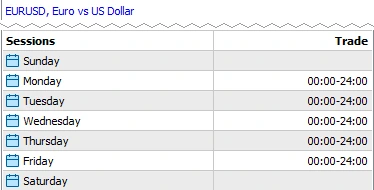
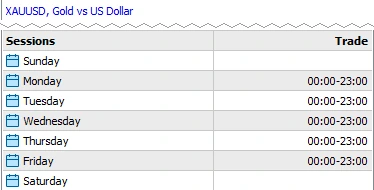
On this server Sunday is empty: the week starts on Monday at 00:00 server time. MetaTrader 4 opens its Contract Specification window the same way; if a symbol's hours are not shown there, your broker's website lists them. Every row of the window is explained in Symbol Specification in MT5 and MT4.
Pictures: MetaTrader 5 on MetaQuotes' demo server, 20 October 2026, the Quotes column left out. Source: MetaTrader 5 help, Market Watch, read 20 October 2026.
Test Yourself
You got 0 of 3.
Questions
What Time Does the London Session Open in My Time Zone?
It opens at 08:00 London time. In New York that is 03:00 in most weeks. In Sydney it is 19:00 in January and 17:00 in July, and in Tokyo 17:00 in winter and 16:00 in summer. The tables above list 17 zones for a July week and a January week, and the graph shows your own.
How Long Is the London and New York Overlap?
Four hours in most weeks: 08:00 to 12:00 New York time and 13:00 to 17:00 London time. It grows to five hours for roughly three weeks a year, when Europe and the United States are on different clock settings. The graph shows a note on those days.
Why Do the Sessions Move in My Time Zone Twice a Year?
Because each session is tied to its own city's clock, not to yours. When London, New York or Sydney changes its clocks, that session shifts by an hour in every zone that does not change on the same day. Tokyo never changes, so its session stays put in a zone that does not either.
Is Sunday 17:00 New York the Official Market Open?
No. It is the usual convention, not an official time, because currency trading has no central exchange. Brokers open and close their servers close to it, and your broker's published trading hours, shown in the symbol's Specification, are the ones that count for your orders.
When Do CME Globex Futures Trade?
Sunday to Friday, 17:00 to 16:00 Chicago time, with a 60-minute break from 16:00 to 17:00 each day. That is what CME Group's contract specifications give for its Euro FX, Gold and E-mini S&P 500 futures on CME Globex, read on 20 October 2026. Holiday hours differ, and the exchange publishes them.
Which Time Zone Does MetaTrader Use?
The broker's server time, not your computer's. The clock in Market Watch shows it. Many servers run at UTC+2 and move to UTC+3 with New York's summer time, and the zone list above has a broker server time entry with that rule. Confirm the offset against your own Market Watch clock.